
AED Magazine Feature
July 2026 Edition
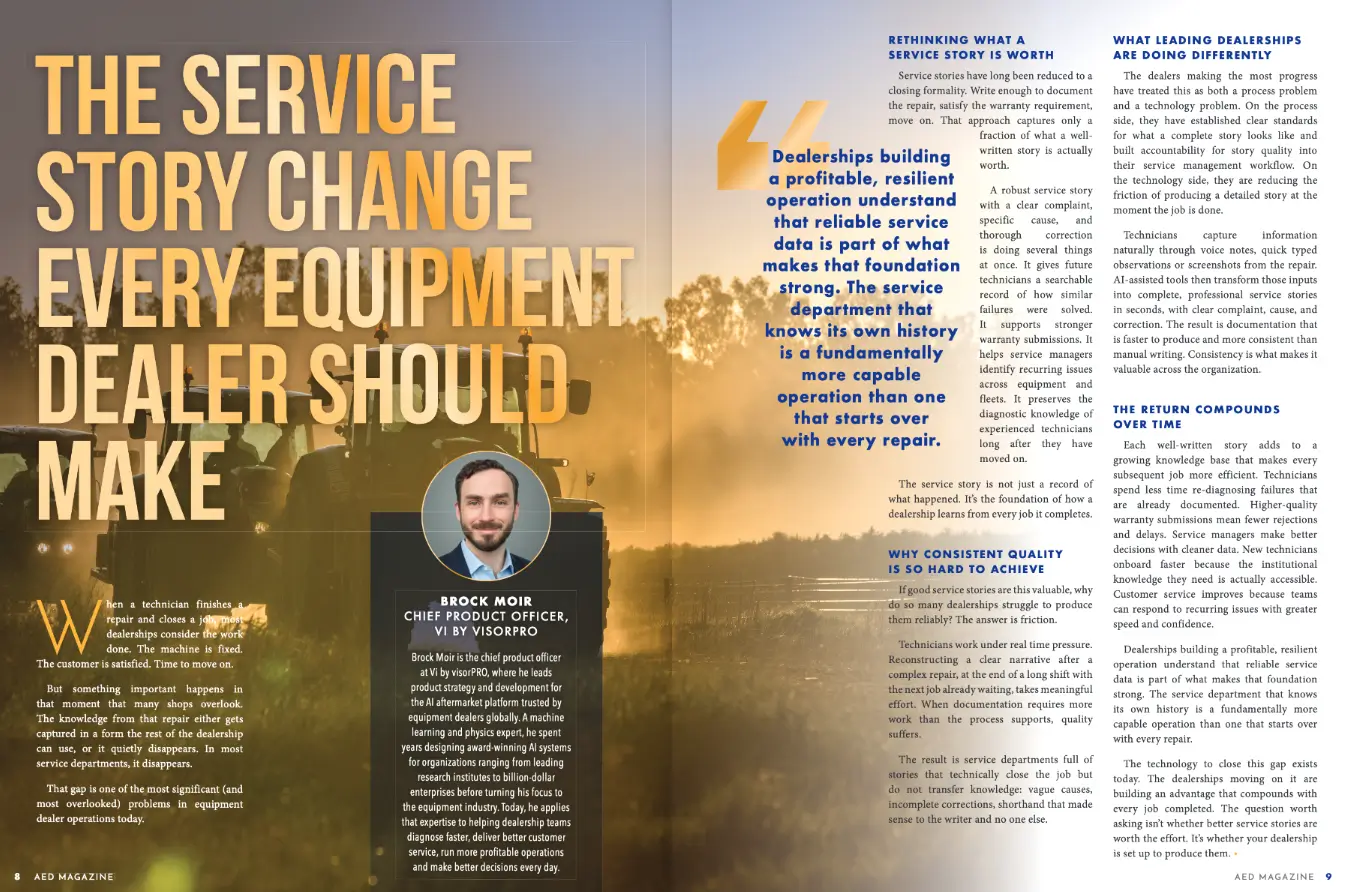
The Service Story Change Every Equipment Dealer Should Make
When a technician finishes a repair and closes a job, most dealerships consider the work done. The machine is fixed. The customer is satisfied. Time to move on.
But something important happens in that moment that many shops overlook. The knowledge from that repair either gets captured in a form the rest of the dealership can use, or it quietly disappears. In most service departments, it disappears.
That gap is one of the most significant (and most overlooked) problems in equipment dealer operations today.
A robust service story with a clear complaint, specific cause, and thorough correction is doing several things at once. It gives future technicians a searchable record of how similar failures were solved. It supports stronger warranty submissions. It helps service managers identify recurring issues across equipment and fleets. It preserves the diagnostic knowledge of experienced technicians long after they have moved on.
The service story is not just a record of what happened. It’s the foundation of how a dealership learns from every job it completes.
Why consistent quality is so hard to achieve
If good service stories are this valuable, why do so many dealerships struggle to produce them reliably? The answer is friction.
Technicians work under real time pressure. Reconstructing a clear narrative after a complex repair, at the end of a long shift with the next job already waiting, takes meaningful effort. When documentation requires more work than the process supports, quality suffers.
The result is service departments full of stories that technically close the job but do not transfer knowledge: vague causes, incomplete corrections, shorthand that made sense to the writer and no one else.
What leading dealerships are doing differently
The dealers making the most progress have treated this as both a process problem and a technology problem. On the process side, they have established clear standards for what a complete story looks like and built accountability for story quality into their service management workflow. On the technology side, they are reducing the friction of producing a detailed story at the moment the job is done.
Technicians capture information naturally through voice notes, quick typed observations, or screenshots from the repair. AI-assisted tools then transform those inputs into complete, professional service stories with clear complaint, cause, and correction in seconds. The result is documentation that is faster to produce and more consistent than manual writing allows. Consistency is what makes it valuable across the organization.
The return compounds over time
Each well-written story adds to a growing knowledge base that makes every subsequent job more efficient. Technicians spend less time re-diagnosing failures that are already documented. Higher-quality warranty submissions mean fewer rejections and delays. Service managers make better decisions with cleaner data. New technicians onboard faster because the institutional knowledge they need is actually accessible. Customer service improves because teams can respond to recurring issues with greater speed and confidence.
Dealerships building a profitable, resilient operation understand that reliable service data is part of what makes that foundation strong. The service department that knows its own history is a fundamentally more capable operation than one that starts over with every repair.
The technology to close this gap exists today. The dealerships moving on it are building an advantage that compounds with every job completed. The question worth asking isn’t whether better service stories are worth the effort. It’s whether your dealership is set up to produce them.
About the author
Brock Moir, Chief Product Officer, Vi by visorPRO
Brock Moir is the Chief Product Officer at Vi by visorPRO, where he leads product strategy and development for the AI aftermarket platform trusted by equipment dealers globally. A machine learning and physics expert, he spent years designing award-winning AI systems for organizations ranging from leading research institutes to billion-dollar enterprises before turning his focus to the equipment industry. Today, he applies that expertise to helping dealership teams diagnose faster, deliver better customer service, run more profitable operations, and make better decisions every day.
See the feature in AED Magazine